By pure distance, Saadani National Park is the closest national park to Dar es Salaam — roughly 150 kilometres of road and about three and a half hours away, sitting right on the Indian Ocean. It is the only mainland park where the beach meets the bush. By the most common meaning of "safari" — a classic big-game game drive — Mikumi National Park is the closest true safari. It is about 283 kilometres away, reachable in roughly four hours by road or three and a half to four hours using the SGR electric train plus a short transfer. Mikumi is the closest big-game park, and the one most operators and travellers mean by "the closest safari to Dar." If you want a one-line verdict: Saadani is nearest on the map, but Mikumi is the closest place to have a proper safari. Just behind them sits Nyerere National Park (the former Selous Game Reserve), the closest premium safari, famous for its river boat trips.
Highlights
- Saadani is the closest national park by distance (~150 km, ~3.5 hrs)
- Mikumi is the closest classic big-game safari (~283 km, ~4 hrs by road or SGR train)
- Nyerere (Selous) is the closest premium safari, a ~45-minute flight from Dar
- Reachable by road, the SGR electric train, or a short flight
- One-day, two-day or three-day itineraries are all realistic from Dar
- Mikumi's Mkata Floodplain is often called the "Mini-Serengeti"
- Saadani is the only mainland Tanzanian park directly on the Indian Ocean
If you are staying in Dar es Salaam — or flying in through Julius Nyerere International Airport on your way to Zanzibar — one question comes up again and again: how quickly can I actually get on a real safari? The good news is that you do not need to fly to the far northern circuit of the Serengeti and Ngorongoro to see lions and elephants. Tanzania's largest city sits on the doorstep of the country's Southern Safari Circuit, and several genuine wildlife destinations are within a single day's reach.
But "closest" is a slippery word, and the honest answer has a twist that most quick blog posts skip. So let's answer it properly.
First, Let's Define "Closest"
Three different measurements of "close" pull in slightly different directions, and understanding them saves you from disappointment on the day.
Closest by distance. On a map, Saadani wins. Parts of its boundary lie under 100 kilometres from Dar as the crow flies, and the driving distance to the nearest access point is around 150 kilometres. Mikumi is a firm 283 kilometres away by the official measure, and Nyerere's main Mtemere Gate is around 230 kilometres.
Closest by travel time. This is where things shuffle. Saadani may be nearer, but the final stretch of road to its gate is rough and slow, so the real door-to-gate time is often three and a half hours or more. Mikumi is farther but sits on the excellent A7 highway that runs all the way to the gate, so the drive is smoother. Add the SGR train and Mikumi can feel closer than Saadani, because a two-hour air-conditioned rail journey does not tire you out the way a bumpy road does.
Closest by experience. If your image of "safari" is a golden plain dotted with elephants, lions under acacia trees and giraffes on the horizon, Mikumi delivers that in a way Saadani cannot match. Saadani is wonderful, but its wildlife is sparser and shyer, spread across coastal woodland rather than concentrated on an open floodplain. The park that is nearest is not necessarily the park that gives you the safari you are picturing.
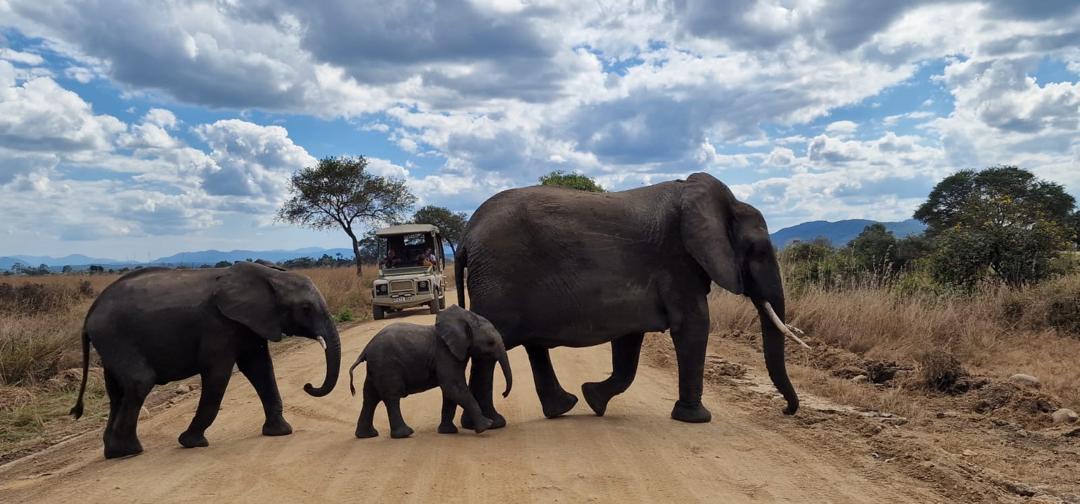
Elephants crossing on the Mkata Floodplain — the classic Mikumi scene, just a few hours from Dar.
Quick Comparison: The Closest Safari Options
| Park | Distance | Travel time | Getting there | Signature experience | Best for |
|---|---|---|---|---|---|
| Mikumi NP | ~283 km | ~4 hrs road / ~3.5–4 hrs SGR + transfer | Road, SGR train, fly-in | Big-game drives on the Mkata Floodplain | Closest classic safari; first-timers |
| Saadani NP | ~150 km road | ~3.5 hrs (rough final stretch) | Road, boat, short flight | Beach-meets-bush; coastal wildlife | Ocean + safari in one |
| Nyerere (Selous) | ~200–230 km | ~5 hrs road / 45 min flight | Road or fly-in | Rufiji River boat safaris | A wilder, premium safari |
| Udzungwa Mts NP | ~300 km | ~5 hrs | Road | Rainforest hiking & waterfalls | Hikers (not game drives) |
| Ruaha NP | ~600 km | Fly-in | Flight | Vast, remote wilderness | Serious safari-goers |
Mikumi National Park: The Closest Classic Safari
Ask ten Dar-based safari operators which park is "the closest safari," and nine will say Mikumi. There is a good reason for that near-consensus.
Mikumi is Tanzania's fourth-largest national park, covering some 3,230 square kilometres, and it was established in 1964. It sits just south of Morogoro town, hemmed in by the Uluguru Mountains to the north and the Rubeho and Lumango ranges to the south-east. Crucially, it borders Nyerere National Park, and together the two form one enormous, connected ecosystem — which is exactly why the wildlife is so rich.
People who know the park often call it the "Mini-Serengeti," and the comparison is fair. The heart of Mikumi is the Mkata Floodplain, a wide, open grassland studded with acacia and baobab trees that looks strikingly like the famous Serengeti plains. Because the terrain is so open, animals are easy to see — you are not straining to spot a leopard hidden in dense forest; you are watching herds move across an unobstructed horizon.
What You'll See in Mikumi
On a typical game drive you can expect elephants, lions, giraffes, zebras, buffalo, wildebeest, hippos and a supporting cast of impala, eland, greater kudu, sable antelope and warthog. Yellow baboons are common near the southern end. The park is also a birding paradise, with more than 400 recorded species — lilac-breasted rollers, bateleur eagles, marabou storks, ground hornbills and, in the wet season, migratory visitors from Europe.
One honest note on the "Big Five": Mikumi has no wild rhino population, so purists describe it as a "Big Four" park — lion, elephant, buffalo and leopard (leopards are present but, as everywhere, seen less often). Three of those four are regularly sighted on a single day's driving, which is a remarkable strike rate for a park this accessible.
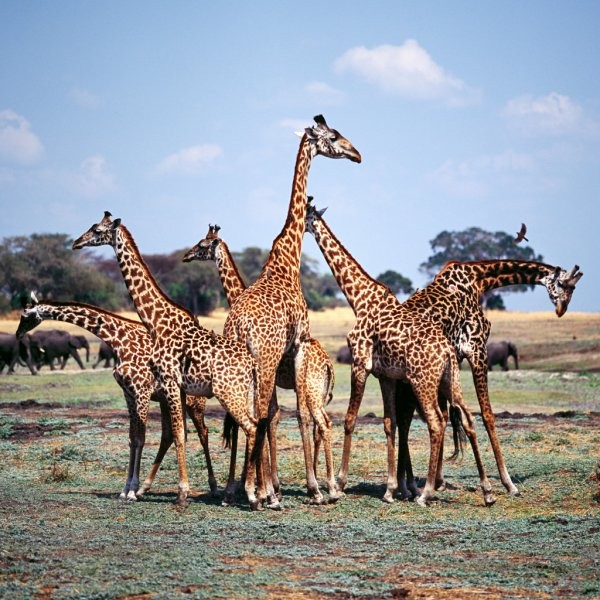
Mikumi's open plains make wildlife — like this giraffes on the Mkata Plains — easy to spot.
Why Mikumi Is the "Closest Safari"
The official distance is 283 kilometres from Dar es Salaam and 118 kilometres from Morogoro. That is farther than Saadani on paper, so why does Mikumi win the title? The answer is the road. The A7 highway — the main artery heading south out of Dar — runs on smooth tarmac right up to and through the park, bisecting it into a northern section (where nearly all game drives happen) and a quieter southern section. There is no long, bone-rattling final approach on a dirt track. You drive good road all the way, and you can be watching elephants by late morning if you leave early.
Getting to Mikumi: Road, Rail or Air
By road (private 4x4): the classic option. Budget four to five hours from central Dar, though it can stretch to six in morning traffic. Leaving Dar by road can eat well over an hour just escaping the city.
By SGR electric train (increasingly the smart choice): the Standard Gauge Railway connects Dar to Morogoro in around two hours — smooth, air-conditioned and inexpensive. From Morogoro you switch to a vehicle for the final ninety minutes to the gate. Total door-to-gate time is about three and a half to four hours, but it feels shorter because the train portion is genuinely restful. You arrive ready for a game drive rather than worn out — which is why many operators now recommend it for day trips.
By air (fly-in): scheduled light-aircraft flights connect Dar es Salaam (and Zanzibar) to Mikumi's airstrip in well under an hour — the fastest and priciest route, popular with travellers combining Zanzibar with a mainland safari.
How Long Do You Need at Mikumi?
A one-day safari is genuinely doable — train or fly in, spend the day on the Mkata Plains, and return by evening. A two-day, one-night trip adds the magical golden hours of dusk and dawn, when predators are most active. A three-day itinerary is ideal if you want to pair game drives with a hike in the neighbouring Uluguru Mountains to a waterfall such as the Choma Falls, or add a Maasai cultural visit.
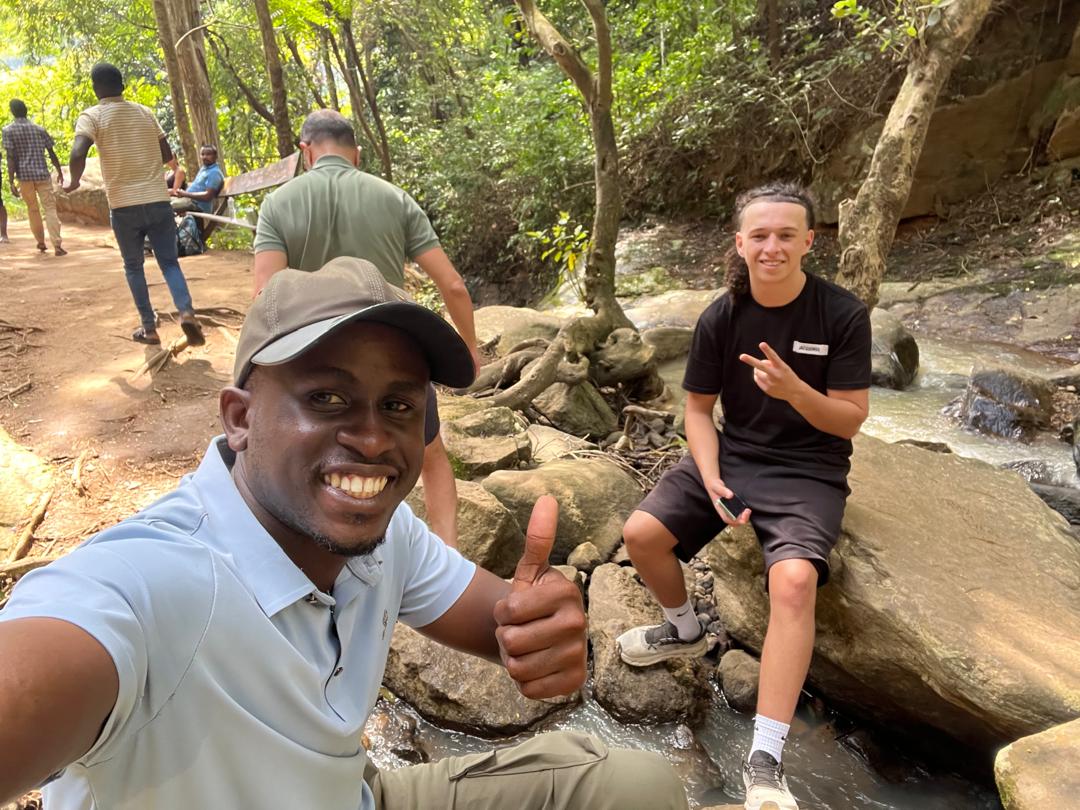
Add the Uluguru Mountains and the Choma Waterfalls to make Mikumi a richer three-day adventure.
Saadani National Park: The Closest Park, and the Only Beach Safari
If distance alone decides the winner, Saadani takes the crown. Several operators plainly describe it as "the closest reserve to Dar es Salaam," and geographically they are right — the park's coastal boundary is nearer to the city than any other national park.
Saadani's claim to fame is genuinely unique: it is the only mainland national park that sits directly on the Indian Ocean. Here, palm-fringed white-sand beaches meet coastal savannah and mangrove-lined river mouths. It is the one place in the country where you might watch elephants against a backdrop of breaking waves, or find lion tracks on the sand. Green turtles nest on its beaches.
What You'll See in Saadani
Saadani is home to four of the Big Five — lion, elephant, buffalo and leopard (no rhino) — along with Masai giraffe, Lichtenstein's hartebeest, sable antelope, waterbuck, greater kudu, eland, wildebeest, yellow baboon and hippo. A standout activity is the boat safari on the Wami River, where you can watch hippos, crocodiles and superb birdlife.
Here is the honest caveat: wildlife in Saadani is not as easily spotted as in the more famous parks. The animals are present but more thinly spread and warier, and the vegetation is denser than Mikumi's open plains. You go to Saadani for the extraordinary mix of ocean and wilderness, the boat trips and the turtles — not to tick off dozens of sightings in an afternoon.
Getting to Saadani
By road, the driving distance is around 150 kilometres, with the fastest routes taking roughly three and a half hours. The catch is the final approach: after a good tarmac run of about 160 kilometres via Chalinze, the last 60-odd kilometres to the gate are on rough, unpaved road. This is why a "closer" park can take about as long as Mikumi. Saadani can also be reached by boat and by short flight — and it is only about 15 minutes by air from Zanzibar, making it a favourite quick safari for beach holidaymakers.
Nyerere National Park (formerly Selous): The Closest Premium Safari
The former Selous Game Reserve — its northern section was upgraded and renamed Nyerere National Park in 2019 — is often called the most well-known safari destination near Dar es Salaam. It is the largest national park in Tanzania and one of the largest protected areas in Africa, yet it receives only a fraction of the crowds you find up north.
Nyerere's main gate lies around 200 to 230 kilometres from Dar, roughly a five-hour drive, or a 45-minute scheduled flight — which is how most visitors arrive. That short hop is a big part of the appeal: you can be deep in genuine wilderness less than an hour after leaving the city.
The signature experience is the Rufiji River boat safari — gliding past pods of hippos, basking crocodiles and drinking elephants as the light turns gold, something Mikumi cannot offer. Nyerere also permits walking safaris with an armed ranger, and protects one of Africa's most important populations of endangered wild dog. It suits travellers who want a wilder, more exclusive safari and have the budget and a night or two to do it justice — a particular favourite for honeymooners.
Honourable Mentions: Three More Options
Udzungwa Mountains National Park (~300 km). Close to Dar and only about 90 minutes from Mikumi, but a different kind of trip: a hiking and biodiversity destination, not a game-drive park — rainforest trails, the Sanje Waterfalls, endemic red colobus monkeys. It pairs brilliantly with a Mikumi safari.
Ruaha National Park (~600 km). By many measures the finest safari park in the south — vast, remote, dramatically beautiful and full of predators. But it is far, and the sensible way in is a flight. Not a "closest" contender, but worth knowing if wildlife quality is your priority.
Pugu Hills / Kazimzumbwi Forest Reserve (~20–30 km). The truly closest patch of wild nature to Dar, on the city's edge — lovely for birdwatching and forest walks, but a forest reserve, not a big-game safari. Butterflies, monkeys and birds, not lions and elephants.
Which One Is Right for You? A Quick Decision Guide
- Choose Mikumi if you want the most reliable classic safari with the least fuss — real big game, open plains, easy access, and the flexibility to go for one day or three. The best all-rounder and the ideal first safari.
- Choose Saadani if combining a beach holiday with a safari excites you more than the number of animals — turtle beaches, a river boat trip and the novelty of the only coastal park. A natural pick from Zanzibar.
- Choose Nyerere (Selous) if you want something wilder and more premium, love the idea of a boat and walking safari, and have the budget and a night or two.
- Choose Udzungwa if you are a hiker who cares more about rainforest, waterfalls and rare primates than the Big Five.
- Choose Ruaha if wildlife quality is your absolute priority and distance is no object — but plan to fly.
Best Time to Visit the Parks Closest to Dar es Salaam
For the big-game parks — Mikumi and Nyerere — the dry season from late June to October is prime. As water sources shrink, animals concentrate around the remaining rivers and waterholes, the grass is short, and visibility is at its best. The short dry spell in January and February is another good window. The green season (November–December and March–May) turns the landscape lush, brings newborns and superb birding, and usually means lower prices and fewer visitors — but some tracks get muddy, and April–May can bring heavy rain.
Saadani follows a similar rhythm, with the important warning to avoid the long rains of April and May, when its dirt access road is at its worst. The reassuring headline: the parks close to Dar offer almost year-round wildlife viewing, so there is no truly "bad" time — only trade-offs between peak sightings, green scenery, crowds and cost.
What to Expect on a Game Drive
A game drive is conducted in a 4x4 vehicle, ideally with a pop-up roof for unobstructed viewing, and always with a knowledgeable guide who reads tracks and knows where wildlife gathers at different times of day. Drives are best in the early morning and late afternoon — the "golden hours" when animals are most active and the light is beautiful; the midday heat sends most animals into the shade. On a park like Mikumi you can realistically expect elephants, giraffes, zebras, various antelope and, with luck, lions and hippos in a single full day. Nothing in the wild is guaranteed — that unpredictability is part of the magic — but the open terrain of the southern parks stacks the odds in your favour.
Practical Tips for a Safari From Dar es Salaam
What to pack: neutral-coloured clothing (beige, khaki, olive — avoid bright white and dark blue), a hat, sunglasses, high-factor sunscreen, insect repellent, a light jacket for chilly early-morning drives, comfortable closed shoes (and hiking shoes for the Uluguru or Udzungwa mountains), binoculars, a camera with a zoom lens, and a reusable water bottle.
Park fees and logistics: Tanzania's park entry fees are set by TANAPA and can change, typically each July. On an all-inclusive tour these are built into your price. Booking through a licensed operator removes the headache of permits and logistics, and a good guide dramatically improves how much wildlife you actually see.
Health and money: consult a travel clinic about malaria prophylaxis before you travel, follow your guide's instructions on safari, and carry travel insurance. US dollars are widely accepted for tours and lodges (bring clean, newer notes); Tanzanian shillings are handy for small local purchases.
Sample Itineraries From Dar es Salaam
- One-day Mikumi safari: early start, SGR train or private vehicle, a full day on the Mkata Plains, back to Dar by evening.
- Two-day Mikumi safari: travel and an afternoon drive on day one with an overnight near the park, then a morning drive on day two — unlocking the best dawn and dusk hours.
- Three-day Uluguru & Mikumi adventure: SGR train to Morogoro, a guided hike to a Uluguru forest waterfall, a full day of Mikumi game drives, and a Maasai cultural experience — the most complete short safari from Dar.
- Coastal safari via Saadani: game drives, a Wami River boat safari and time on the beach — bush and beach in one.
- Fly-in Nyerere (Selous) safari: a 45-minute flight, a Rufiji River boat safari and classic drives, with a night at a riverside camp.