In Short
Two days, one night and three budget routes: Tarangire and Ngorongoro Crater, Lake Manyara and Ngorongoro, or a short southern-parks escape to Mikumi or Nyerere (Selous). Prices start at $420 per person when you join a group, and include a 4x4 Land Cruiser with pop-up roof, an expert English-speaking driver-guide, park fees, camping or a basic lodge, and all meals. Private departures cost more; send us your dates and group size for an exact quote.
On This Page
Overview
A 2-day budget Tanzania safari costs from $420 to about $750 per person, depending on the route, the season, and whether you join a group or travel privately. Mid-range, small-group versions of the same routes run roughly $600 to $960+ per person. Each route visits some of Tanzania’s best-known parks: Tarangire for large elephant herds and giant baobabs, Lake Manyara for tree-climbing lions and birdlife, the Ngorongoro Crater for the best chance in Tanzania of seeing the Big Five in one day (rhino and leopard are never guaranteed), and, in the south, Mikumi and Nyerere (Selous) for game drives, boat safaris and walking safaris. You travel in a 4x4 Land Cruiser with a pop-up roof, with an expert English-speaking driver-guide, and spend a full day on safari. Nights are in budget campsites or basic lodges, and all meals are included.

- Three routes to choose from: Tarangire & Ngorongoro, Lake Manyara & Ngorongoro, or Mikumi/Nyerere
- A full morning inside the Ngorongoro Crater, Tanzania’s best place to look for the Big Five in one day
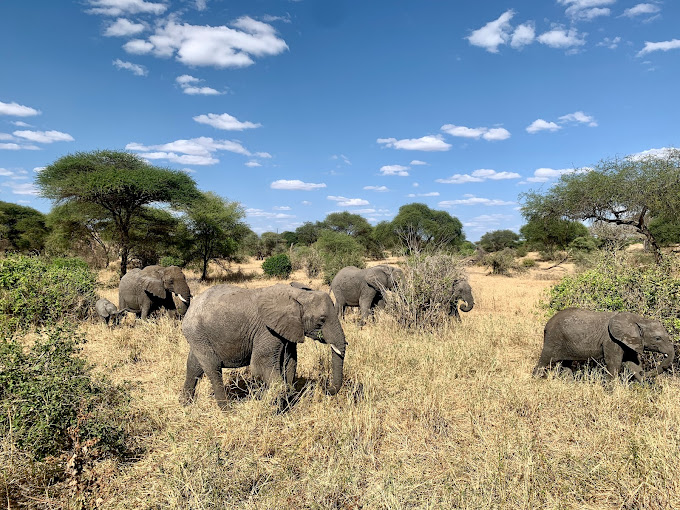
- Tarangire’s giant baobabs and some of Tanzania’s largest elephant herds
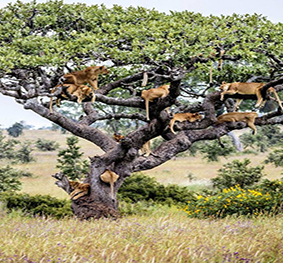
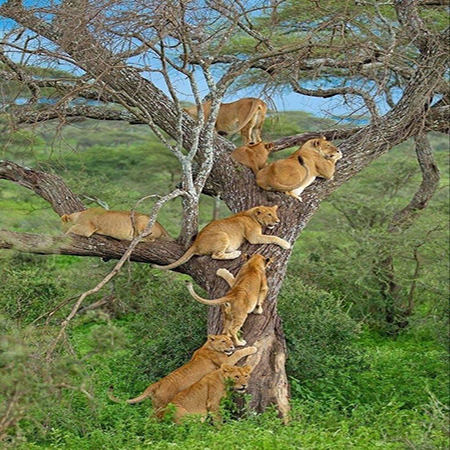
- Lake Manyara’s tree-climbing lions, hippos and birdlife
- Boat, walking and game-drive options in Nyerere (Selous) and Mikumi
- 4x4 Land Cruiser with pop-up roof and an expert English-speaking driver-guide
- Park fees, camping gear or basic lodge, and all meals included
- Shared (group-joining) or private departures
- Route 1, Day 1: Arusha to Tarangire, full-day game drive, overnight near Karatu
- Route 1, Day 2: Ngorongoro Crater game drive, return to Arusha
- Route 2, Day 1: Arusha to Lake Manyara, game drive, overnight near Ngorongoro
- Route 2, Day 2: Ngorongoro Crater game drive, return to Arusha
- Route 3, Day 1: Dar es Salaam or Zanzibar to Mikumi or Nyerere, afternoon safari
- Route 3, Day 2: Morning safari, return to Dar es Salaam or Zanzibar
Detailed itinerary
Route 1: Tarangire and Ngorongoro Crater
Day 1: Arusha to Tarangire
Your driver-guide collects you from your hotel in Arusha or Moshi, briefs you on the day and loads the camping gear and supplies. Drive to Tarangire National Park, about 2.5 to 3 hours.
Follow the Tarangire River, where large elephant herds gather among giant baobab trees. Look for giraffe, zebra, wildebeest, buffalo and more than 500 bird species.
Lunch at a picnic site inside the park.
Continue exploring for lions resting in the shade, elephants at the river and warm afternoon light for photographs.
Leave the park and drive about 2 hours to Karatu, the gateway to the Ngorongoro Conservation Area. Dinner and overnight at campsite near tarangire or mto wa mbu.
Day 2: Tarangire to Ngorongoro Crater
Breakfast, then an early start so you are on the crater rim in the best morning light.
Stop at the rim for the view, then descend the steep road onto the crater floor, one of the world’s largest unbroken volcanic calderas.
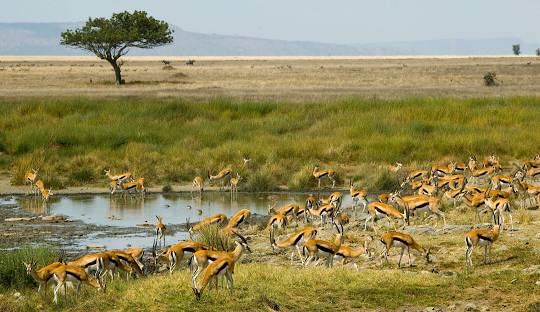
Look for lions, spotted hyenas, buffalo, elephants, hippos, zebra and wildebeest. Black rhino and leopard are possible but never guaranteed.
Lunch at the picnic site, then a last scenic drive before you climb out. Time on the crater floor is limited to about six hours.
Drive back to Arusha, about 3.5 to 4 hours, with drop-off at your hotel around 17:30 to 18:00.
Route 2: Lake Manyara & Ngorongoro Conservation Area
Day 1: Arusha to Lake Manyara
Your driver-guide collects you in Arusha or Moshi. Drive to Lake Manyara National Park via Mto wa Mbu, about 2 to 2.5 hours.
Drive through the groundwater forest and along the lake shore. Look for baboons, blue monkeys, elephants, giraffe, buffalo and hippos. Manyara’s tree-climbing lions are an occasional bonus and cannot be guaranteed
Lunch at a picnic site in the park.
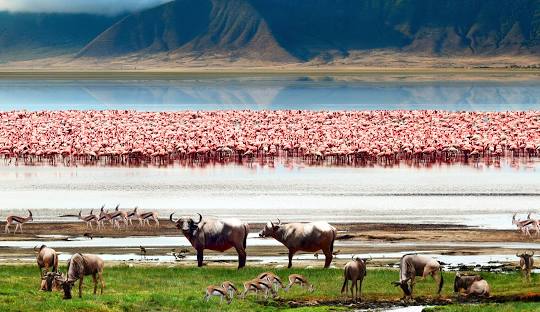
Scan the lake shore for flamingos and other water birds. Flamingo numbers vary with the season and the lake level.
Drive about 1 hour towards the Ngorongoro Conservation Area. Dinner and overnight at campsite or lodge near Karatu.
Day 2: Ngorongoro Conservation Area
Breakfast, then an early start so you are on the crater rim in the best morning light.
Stop at the rim for the view, then descend the steep road onto the crater floor, one of the world’s largest unbroken volcanic calderas.
Look for lions, spotted hyenas, buffalo, elephants, hippos, zebra and wildebeest. Black rhino and leopard are possible but never guaranteed.
Lunch at the picnic site, then a last scenic drive before you climb out. Time on the crater floor is limited to about six hours.
Drive back to Arusha, about 3.5 to 4 hours, with drop-off at your hotel around 17:30 to 18:00.
Route 3: Mikumi and Nyerere (Selous) National Parks
Day 1: Mikumi National Park
Mikumi: drive from Dar es Salaam, about 4.5 to 5 hours. Nyerere: short domestic flight from Dar es Salaam or Zanzibar into the park, about 45 to 60 minutes (flight not included in the price).
Check in at your camp or basic lodge and have lunch.
Mikumi: game drive across the Mkata Floodplain for elephants, giraffe, zebra, buffalo, hippos and lions. Nyerere: boat safari on the Rufiji River for hippos, crocodiles and birdlife, or a game drive.
Dinner and overnight at camp or a basic lodge.
Day 2: Nyerere (Selous) National Park
Mikumi: early game drive when animals are most active. Nyerere: walking safari with an armed ranger or a morning game drive.
Breakfast, pack up and say goodbye to the bush.
Mikumi: drive back to Dar es Salaam. Nyerere: flight back to Dar es Salaam or Zanzibar. Arrival times depend on traffic and flight schedules.
Timings are a guide and flex with the season, road conditions and the wildlife.
Distances & Travel Time
Approximate road and flight legs for each route.
| Route | Distance | Travel Time |
|---|---|---|
| Arusha to Tarangire (road) | 120 km | 2.5 to 3 hrs |
| Tarangire to Karatu (road) | 100 km | 2 hrs |
| Arusha to Lake Manyara (road) | 125 km | 2 to 2.5 hrs |
| Lake Manyara to Karatu (road) | 50 km | 1 hr |
| Karatu to Ngorongoro Crater floor | 30 km | 1 hr |
| Ngorongoro Crater to Arusha (road) | 180 km | 3.5 to 4 hrs |
| Dar es Salaam to Mikumi (road/SGR) | 285 km | 4.5 to 5 hrs |
| Fly-in to Mikumi from Dar or Zanzibar | 350 km | 1 to 1.5 hrs |
| Dar es Salaam or Zanzibar to Nyerere (flight) | 230 km from Dar | 45 to 60 min |
2-day budget Prices for 2026-2027
Prices are per person and depend on your route, the season, the number of travelers, and whether you join a shared group (up to 6 guests per vehicle) or travel privately. Park fees and all meals are included.
| Group size | Route 1: Tarangire & Ngorongoro | Route 2: Lake Manyara & Ngorongoro | Route 3: Mikumi / Nyerere (Selous) |
|---|---|---|---|
| Price per person (USD) | $420 – $533+ | $440 – $750 | $500 – $620 |
Mid-range and small-group versions of these routes, staying in lodges instead of camping, are roughly $600 to $960+ per person depending on parks and season. Domestic flights to Nyerere are not included. Ask for an exact quote for your dates and group size.
Where You'll Stay For Budgeted Safari
Budget camping (standard): you stay in public campsites managed by the national park authorities. You sleep in two-person dome tents on ground mattresses, with tables and chairs provided. Facilities are basic: shared bathrooms and cold or solar-heated showers. Bring a light sleeping bag, or rent one from us for a small fee.
Basic lodge (where available): some routes can use simple lodges with a private room. Ask us when you request your quote.
Safety: public campsites are unfenced, so animals can pass through at night, but rangers monitor them. Following your guide’s rules, such as never keeping food in your tent, keeps risks very low.
What's included
- • 4x4 Land Cruiser with pop-up roof
- • Expert English-speaking driver-guide
- • Park entry and concession fees, including the Ngorongoro Crater service fee (Routes 1 and 2)
- • Camping gear (tents, mattresses, tables and chairs) or a basic lodge
- • All meals: breakfast, lunch and dinner
- • Pick-up and drop-off at the start and end point of your route.
What's excluded
- • International and domestic flights, including flights to Nyerere
- • Tips and gratuities for the driver-guide and cook
- • Travel and medical insurance
- • Alcoholic beverages and soft drinks
- • Visa fees and personal items
- • Sleeping bag rental (optional, small fee)
What you'll see
These parks cover very different habitats, so your wildlife list changes by route. Here is what to look for, and how likely you are to see it.

| Animal | Likelihood |
|---|---|
| Elephant | Very likely in Tarangire (large herds along the river). Also seen in Ngorongoro (mostly big bulls), Manyara, Mikumi and Nyerere. |
| Lion | Likely in Tarangire, Ngorongoro, Mikumi and Nyerere. Lake Manyara’s tree-climbing lions are an occasional bonus. |
| Buffalo | Very likely in all parks. |
| Giraffe, zebra and wildebeest | Very likely across the parks on all three routes. |
| Hippo and crocodile | Very likely at Manyara’s hippo pools, the crater’s hippo pool, and on Nyerere boat safaris. |
| Black rhino | Possible in the Ngorongoro Crater; sightings are usually distant and never guaranteed. |
| Leopard | Rare. Occasionally seen in Tarangire, Manyara and the woodland around the crater. |
| African wild dog | Possible in Nyerere; never guaranteed. |
| Flamingos and water birds | Seasonal at Lake Manyara and the crater’s Lake Magadi, depending on water levels. |
| Birds | Excellent birding in Tarangire (500+ species), Lake Manyara and Nyerere. |
Best time to visit
You can take a 2-day safari all year. June to October is best for wildlife and dry camping. March to May has the lowest prices but the heaviest rain. Ngorongoro Crater is good year-round, and the crater rim is cool, so bring a warm layer in any season.
Good to know
- The Serengeti is not realistic on a 2-day trip: the drive from Arusha takes 7 to 8 hours each way.
- Shared safaris put individual travelers in one 4x4 (up to 6 guests) on set departure dates.
- Pack light, breathable clothing in neutral colors, a warm layer for early mornings and the crater rim, comfortable shoes, sun protection, binoculars, and a camera with spare batteries.
- Bring a light sleeping bag, or rent one from us for a small fee.
- Tips for the driver-guide and cook are not included. Ask us for the recommended amount.
- Fitness level is easy: most of the time is spent in the vehicle
Frequently asked questions
Justus Kahwa
Puts together Tanzania safari itineraries most weeks, sequencing each around the guest's flights and the season, and would rather send the route that fits than the one already on the shelf. This one includes three routes to choose from: Tarangire & Ngorongoro, Lake Manyara & Ngorongoro, or Mikumi/Nyerere.